BCPFFA Secures Historic Expansion of Occupational Cancer Coverage for Fire Fighters
FOR IMMEDIATE RELEASE: March 2, 2026
BRITISH COLUMBIA – The Government of British Columbia, in partnership with the BC Professional Fire Fighters’ Association (BCPFFA), has strengthened health protections for fire fighters. Under the leadership of Premier David Eby and Minister of Labour Jennifer Whiteside, the province has added eight new types of cancer to the presumptive coverage list under the Workers’ Compensation Act and has met the national standard for coverage of esophageal cancer.
This announcement marks a significant advancement under the regulations of the Workers’ Compensation Act, establishing British Columbia as a leader in firefighter safety. The government has reduced the service-year requirement for esophageal cancer and shifted the legal burden of proof away from individuals, ensuring that all BC fire fighters, including structural and wildland personnel, receive the protection and support they deserve.
“Those who risk their lives to protect us deserve to be protected, too. Fire Fighters often face hazardous situations, we’re making sure they have support when they need it the most.”
Eliminating the Burden of Proof: The 2026 Expansion Details
"Presumptive coverage" is a crucial legal tool in occupational health that simplifies the claims process for firefighters and their families. Historically, firefighters had to prove that their cancer was linked to workplace exposures, a challenging task due to the long latency of these diseases. The government has removed this burden, allowing WorkSafeBC to automatically consider these illnesses work-related for eligible individuals, which speeds up access to essential benefits and support. The 2026 expansion adds eight cancers to the presumptive list, reflecting the profession's specific risks.
Respiratory System: Tracheal, Bronchial, Laryngeal, Nose, and Pharyngeal cancers.
Skin Cancer: Recognizing high rates of toxin absorption through personal protective equipment (PPE).
Mesothelioma: Addressing persistent, long-term risks associated with asbestos exposure.
Soft Tissue Sarcoma: Covering malignancies within the body's connective tissues.
Amended the Esophageal cancercumulative service-yearrequirement from 20 to 15 years. This reduction mirrors the precedent set by Ontario and acknowledges the acute occupational hazards unique to firefighting. These legal protections are not merely policy shifts; they are built upon a foundation of rigorous scientific data.
The Scientific Mandate: Mortality Data and Global Classifications
The selection of specific cancers is a direct response to the "lethal realities of the modern fire environment." Firefighters today work in "toxic soup" environments where synthetic materials release harmful carcinogens absorbed through the skin and inhaled despite advanced PPE. In 2022, the International Agency for Research on Cancer (IARC) reclassified firefighting as a Group 1 Carcinogen, establishing a definitive link to cancer. (IARC Monographs Volume 132). This reclassification highlights the urgent need for legislative action, as occupational cancer accounts for 84.6% of line-of-duty deaths in the fire service from 2007 to 2021. (Samar Al-Hajj et al, 2025). By recognizing these illnesses as protected occupational injuries, the Province is addressing a clear danger with evidence-based actions.
British Columbia’s National Leadership in Fire Fighter Health
Since 2005, British Columbia has maintained a consistent trend of expanding protections to meet the evolving understanding of occupational risks. With the 2026 additions, B.C. provides the most comprehensive coverage in the country.
Provincial Comparison of Presumptive Cancer Types
Key legislative milestones:
2005: Initial recognition of 8 cancers {Brain, Bladder, Colorectal, Kidney, Ureter, Primary non-Hodgkin's Lymphoma, and primary leukemia, Testicular};
2008–2014: Addition of Lung, Esophageal, and Heart Disease;
2017–2018: Addition of Breast, Prostate, Myeloma; recognition of Occupational Stress Injuries (OSI);
2022: Cervical, Ovarian, Penile, Pancreatic, Thyroid and reductions in cumulative periods in Testicular, Colorectal, Esophageal;
2026: Addition of 8 new cancers and further reduction of the cumulative risk for Esophageal
While these compensation frameworks are vital, the BCPFFA’s vision is to look to the future, defined by prevention.
Leadership Insights and Interjurisdictional Strategic Alignment
The 2026 expansion serves as a blueprint for an effective labour-government partnership. The Ministry of Labour, under Minister Jennifer Whiteside, has facilitated this science-based response as a proactive measure of provincial leadership.
“Expanding the list of presumptive cancers and lowering the cumulative service for esophageal cancer acknowledges the risks we face on the job. It also underscores the Provincial Government’s commitment to the health and safety of all fire fighters. This is the strongest set of protections in the country, and the BCPFFA will continue to advocate for the health, safety, and support for all members.”
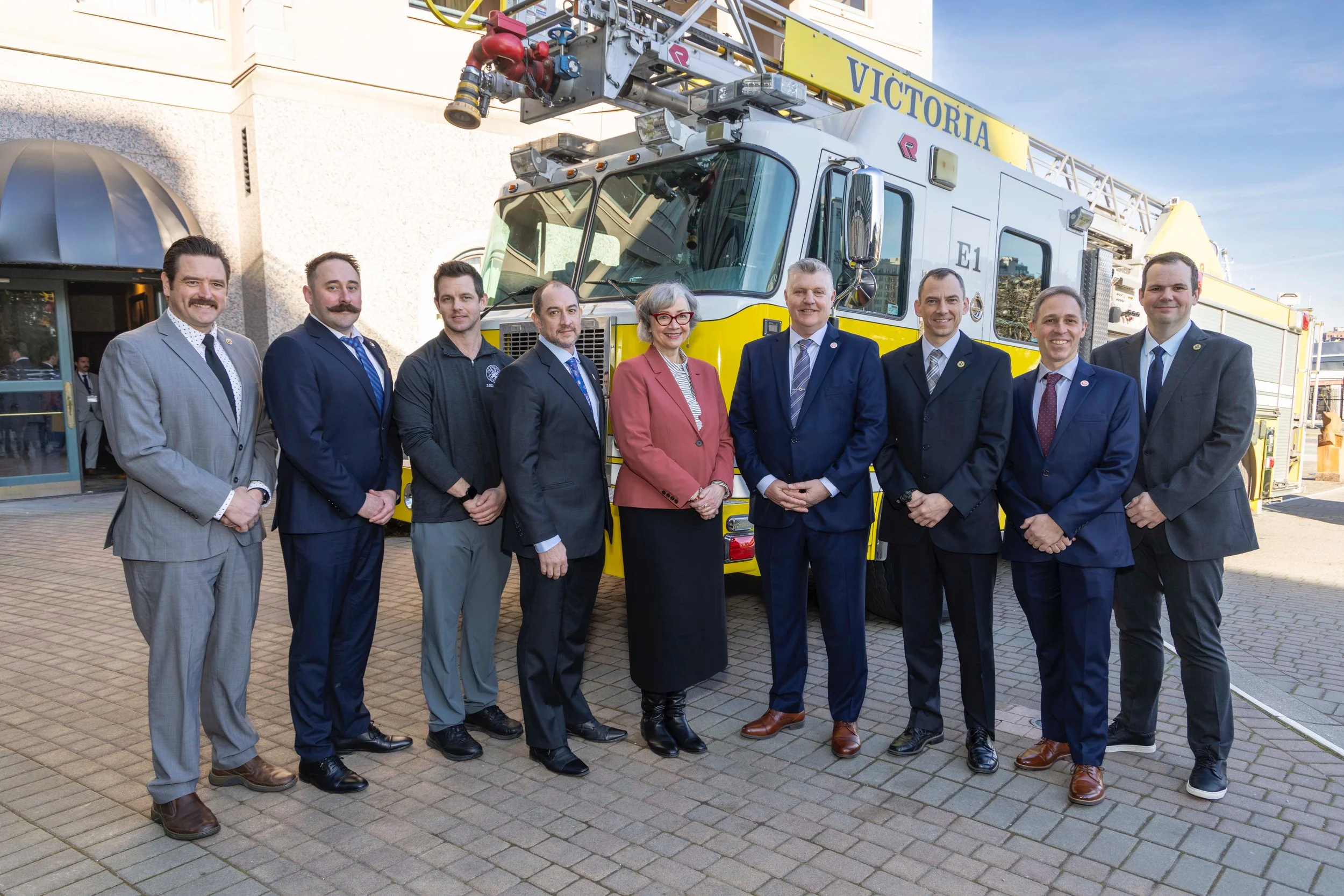
Hon. Minister Whiteside with BCPFFA President Todd Schierling and the leadership of Local 1782 Coquitlam (left) and Local 256 New Westminster (right)
“Fire Fighters put themselves in difficult and sometimes hazardous situations to save people and property. These updates help ensure that firefighters who develop
certain cancers have timely access to workers’ compensation benefits and supports during a time when they
need it most.”
The Path Forward: A Collaborative for Prevention and Early Detection
Provincial momentum has led to strategic alignment at the federal level. Schierling highlights a strong message from Minister of Labour, Hon. Jennifer Whiteside, to the Federal Minister of Health and Minister of Industry. In late 2025, Minister Whiteside discussed an "automatic exposure registry" with MP Mélanie Joly, aimed at documenting real-time carcinogenic exposure through fire incident reporting. Minister Joly emphasized B.C.’s leadership is "critical to the success of the registry," positioning the province as a key architect for a future national occupational health data framework.
““The primary objective is to foster a proactive approach to the prevention of illness among all fire fighters, encompassing structural, wildland, and Indigenous categories. This comprehensive strategy underscores the provincial government’s steadfast commitment to those who safeguard the public, ensuring that they return home in good health at the conclusion of their duties.” ”
The next frontier in fire fighter safety is the shift from "coverage after diagnosis" to the active "avoidance of illness." The BCPFFA’s vision is to work with the Government of British Columbia to support a path forward of collaboration with stakeholders to implement advanced decontamination protocols and standardized health screenings across the province. The proposed collaboration would bring together: The Ministries of Health, Labour, Public Safety, and the Office of the Fire Commissioner, BC Cancer Research, Doctors of BC, BC General Employees Union, BC Wildland Fire Fighters Service, The Fire Chiefs’ Association of BC, Greater Vancouver Fire Chiefs’ Association, The Union of BC Municipalities, Indigenous groups, Health Economists, Statistics Canada, BC Municipal Safety Association and WorkSafeBC.
On behalf of the BCPFFA, “We thank the Provincial Government and all Members of the Legislative Assembly for their continued support of fire fighters and all first responders.
— BCPFFA President Todd Schierling
Relevant Information
References
Media Contact
Jane Spitz, Communications Manager
c: 604.916.8499
ABOUT THE BCPFFA
The BC Professional Fire Fighters' Association is a non-profit organization established in 1929 that represents over 5,000 professional firefighters, dispatchers, and support members across 56 local unions in British Columbia and the Yukon. As an affiliate of the International Association of Fire Fighters, the association provides advocacy, training, and support for its members, with a strong focus on health, safety, and legislative lobbying.
- 30 -